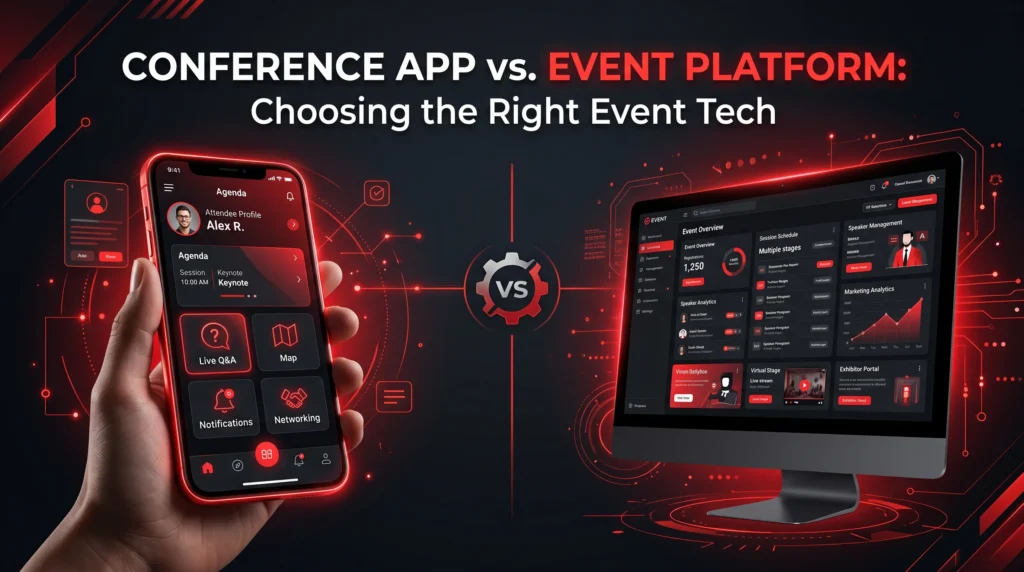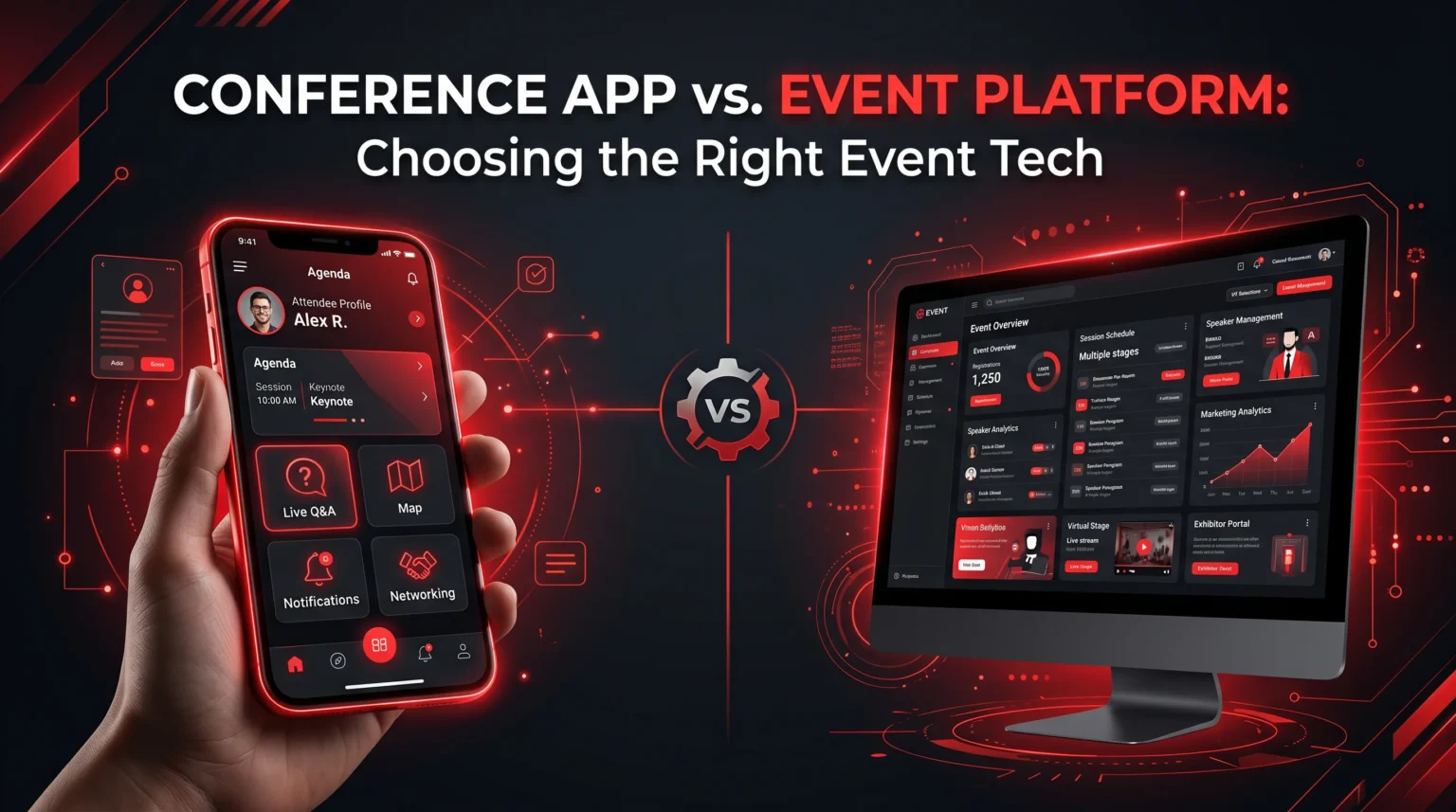
The terms “conference app” and “event platform” are often used interchangeably in sales decks and vendor conversations. However, they are not the same thing, and choosing the wrong one can mean missing critical features and a disjointed experience for attendees and your event team.
The conference app is where attendees spend their time, while the other is where organizers run the operation. Organizers must understand what each does and where they overlap or diverge. This guide will break down their key differences and help you choose the right tool for your event.
A conference app is the attendee-facing product. It is what someone downloads to their phone before arriving at the event and uses throughout the conference day to navigate sessions, connect with other attendees, receive updates, and engage with content.
Some of the core features a good conference app offers include:
- Personalized agenda building with multi-track filtering and session reminders
- Speaker profiles and session detail pages
- 1:1 messaging, group chats, and community channels
- Meeting scheduling with calendar sync
- QR-based contact exchange for in-person networking
- Push notifications and real-time schedule updates
- Offline access to keep the content available when the venue Wi-Fi drops
- In-app session ratings and feedback surveys
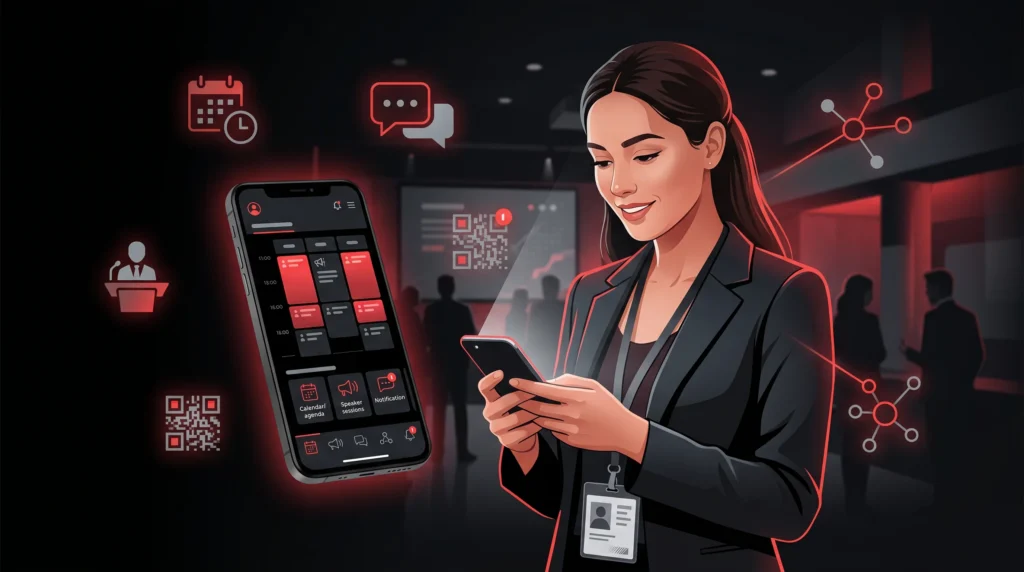
The conference app is what attendees actually see and touch. Its quality shapes their perception of the event, and in many cases, more than the venue and content. About 82% of convention attendees use mobile devices during the event, so the app experience is closely tied to the conference experience for most attendees.
An event platform is broader. While it may include all conference app functionalities, it supports a wider range of event types and sits at the center of the entire event ecosystem. A general event platform covers:
- Event website creation and branded registration pages
- Ticketing and payment processing
- Email marketing and pre-event communications
- Venue sourcing and logistics management
- On-site check-in and badge printing
- Post-event reporting and analytics
- Integration with CRM, marketing, and membership tools
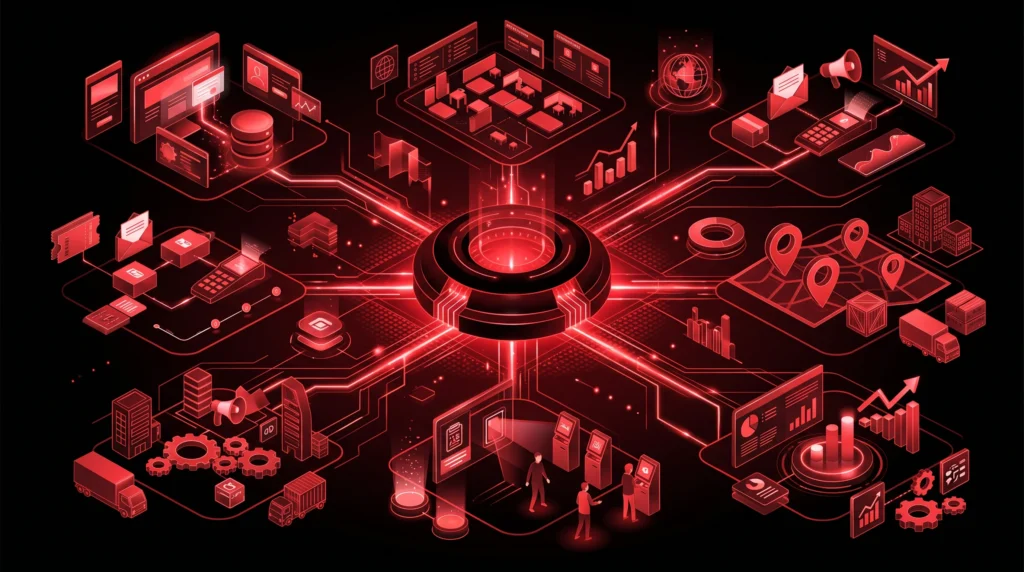
Event platforms aim to support all types of events, including company town halls, trade shows, multi-day international summits, and more. They are useful for organizations managing diverse event portfolios. However, a platform that serves every event type does not go as deep on any single one as a tool purpose-built for that format.
Where the Confusion Comes From
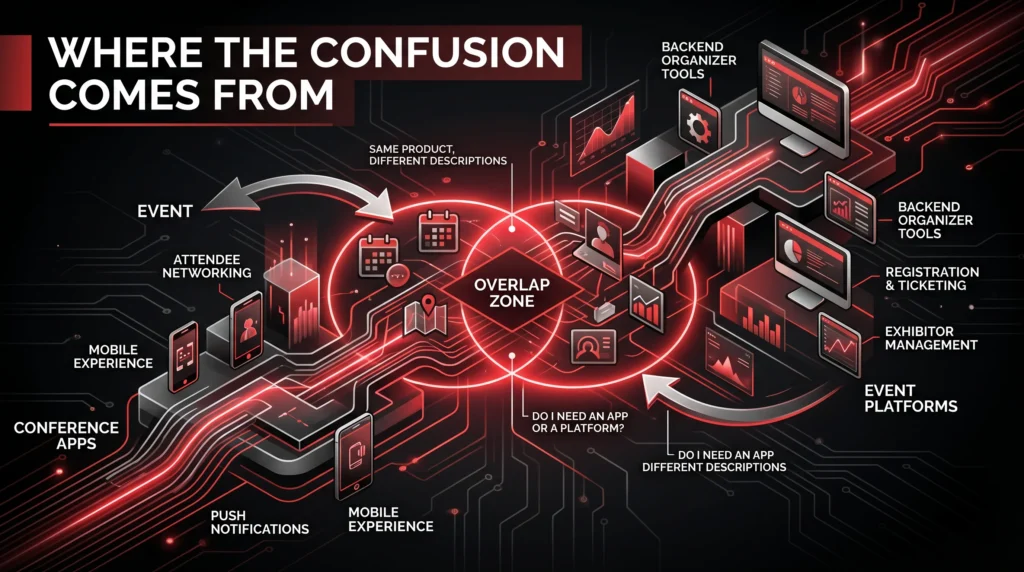
The overlap between conference apps and event platforms has grown over the past few years as both categories have expanded. Most event platforms now include a mobile attendee experience. Similarly, many conference apps have added backend organizer tools.
The result is a market where the same product can legitimately be described as both. This makes the question “do I need an app or a platform?” harder to answer than before.
The more useful question now is: what does your event require, and does the tool you are evaluating deliver it to the depth you need?
For example, a corporate HR team running four internal town halls per year has different requirements than a conference organizer managing a three-city summit series with sponsors, exhibitors, multi-track agendas, and an attendee community that needs to stay connected between events. The same product is very unlikely to serve both groups well.
The Key Differences Side by Side
| Feature | Conference App | Event Platform |
| Primary user | Attendees | Organizers |
| Core function | Engagement and navigation | Planning and operations |
| Networking depth | Deep | Varies from platform to platform |
| Agenda management | Session-level, personalized | Event-level, structural |
| Offline access | Often included | Rarely |
| Sponsor tools | Profiles and engagement | Varies |
| AI features | Matchmaking, recommendations | Growing, inconsistent |
| Best for | Conference-day experience | End-to-end event logistics |
Where You Need Both / Where One Is Enough
A general event platform with a basic attendee-facing component is sufficient for smaller or simple events. The logistics are manageable, and the attendee experience does not require deep networking infrastructure or personalization. For example, a small professional association gathering or community-led seminar with fewer than 100 attendees may require only registration handling and a minimal attendee-facing experience.
The other scenario is serious conferences/events, such as multi-track programs, sponsor commitments, networking-focused audiences, and multi-city series. This requires that the attendee app and the organizer console be strong and connected.
A powerful backend paired with a weak attendee app results in an event that runs smoothly for the organizer but falls flat for everyone else. A beautiful attendee app with no real backend control produces the opposite problem, i.e., attendees have a good experience right up until something changes on the day, and the organizer cannot push an update in time.
The strongest conference setups are ones where the app and the platform are not two separate products being held together by an integration. They are the same connected system that works together from the ground up.
The AI Influence in the Distinction Between Conference App and Event Platform
AI is becoming a standard component of conference technology. So, the gap between specialist conference platforms and general event tools is widening.
AI networking suggestions, personalized agendas, automated content summaries, and chatbots answering attendee questions are becoming standard expectations rather than premium add-ons. General event platforms are adding these features incrementally. Tools built specifically for conferences are integrating them within the core design. And that difference shows up on event day.
The organizers who are offering the best event day experience with the best technological infrastructure are the ones who stopped asking “app or platform?” and started asking “does this tool do both in one place?”
Conphere — The Platform Built for Both
Conphere is a premium conference management platform that delivers a polished attendee app and a powerful organizer console in a single connected system. It offers a one conference ecosystem that connects attendee engagement with operational management.
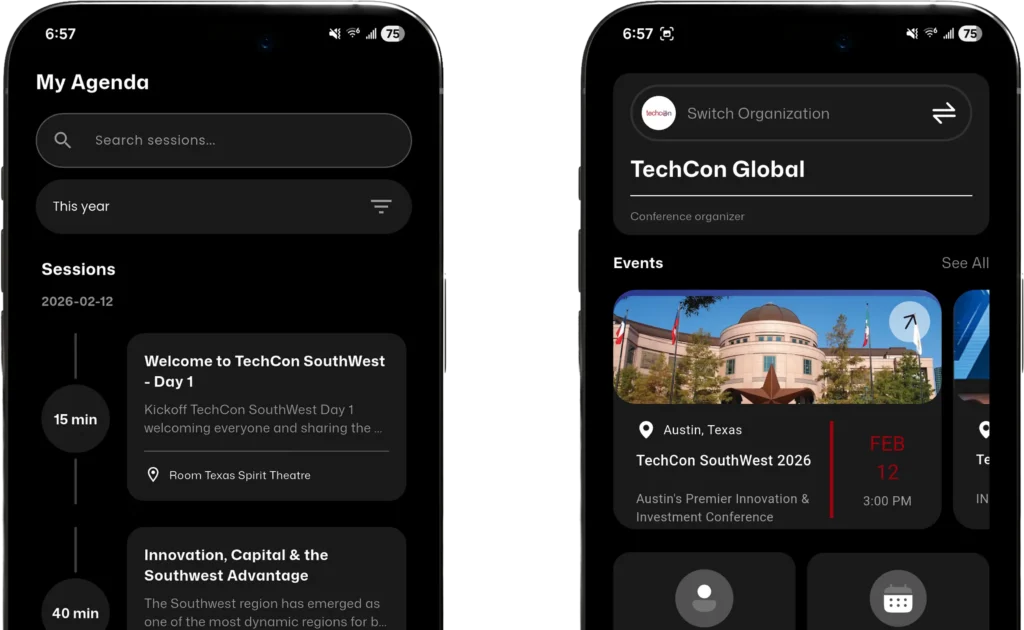
The platform includes:
- Native iOS and Android attendee app with offline access
- Organizer console with real-time engagement visibility and multi-event management
- 1:1 messaging, group chats, moderated channels, and AI-powered matchmaking
- Live announcements, emergency alerts, and instant schedule updates
- Sponsor ROI reporting, session feedback, and post-event analytics
- Plugin integrations for ticketing, email, and membership tools
Conphere provides top-notch attendee engagement before, during, and after the conference, while giving organizers the key tools to manage conferences.
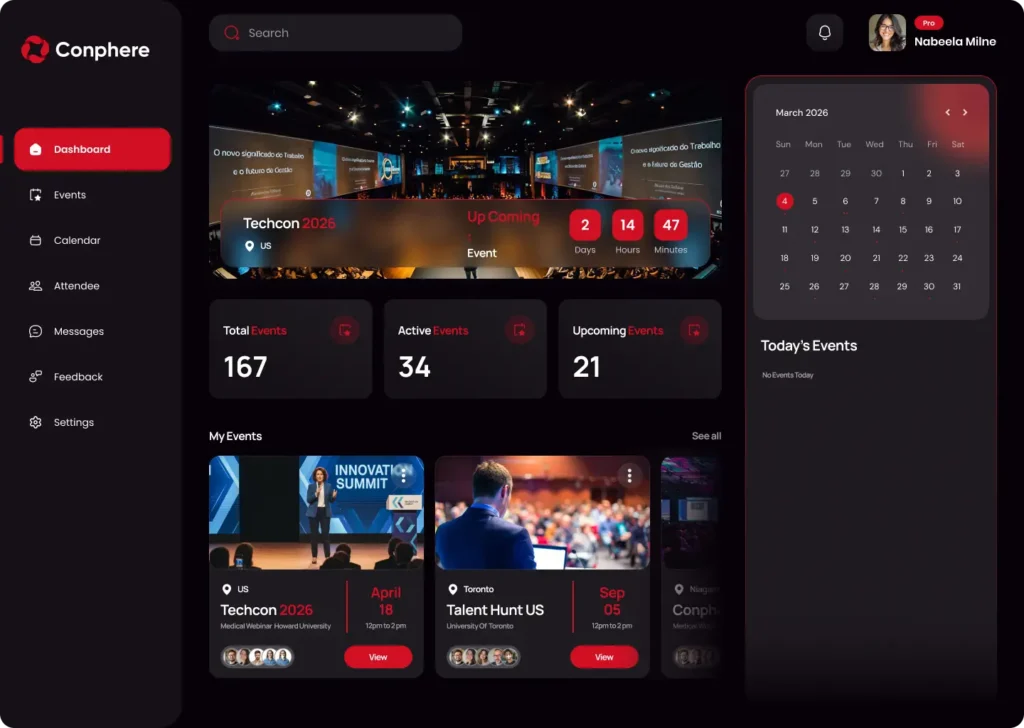
Now the interesting question is whether we call Conphere a conference app or an event platform. The answer is BOTH.
Modern conferences no longer separate attendee experience from operational execution. Conphere is a platform built on the idea that engagement, communication, networking, and event management should work together as a single, connected conference system.
Try out Conphere for free and explore its features yourself.
The difference between a conference app and an event platform is real. One serves your attendees. One serves your operations. However, the modern/feature-packed conference tools do both. It provides a single system that connects attendee engagement, communication, networking, analytics, and operational management. That is what to look for in 2026.