There was a time when organizing one big annual conference was the centerpiece of event strategy. Companies would invest heavily in one flagship event, plan for months, and execute it in two or three days. The event either worked or it didn’t. Either way, the team would start the cycle again for the next twelve-month period. That model is becoming a disadvantage.
Organizers are now running a connected conference series model. It involves multiple events under one program that build on each other over a calendar year. This model is outperforming in attendee retention, sponsor revenue, community depth, and long-term engagement. Those still treating each event as a standalone project are finding it harder to compete and grow.
The One-Off Model Has a Structural Problem
A single annual conference has one major limitation that most organizers never fully confront, namely that everything depends on two or three days going well. It requires an enormous investment in planning, yet the execution window is narrow. The moment the event ends, the community you spent months building begins to evaporate.
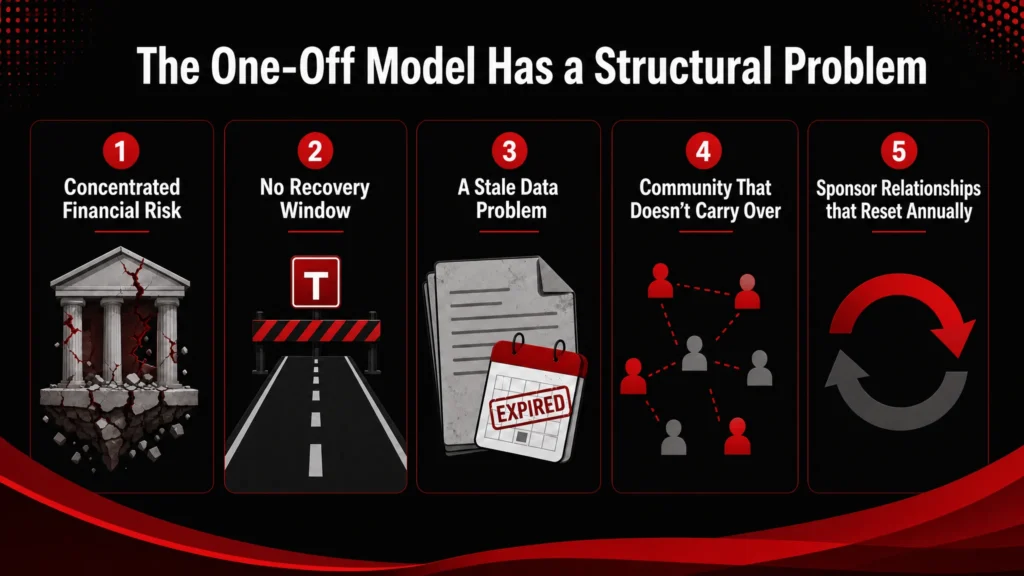
The core problems with the one-off model include:
● Concentrated Financial Risk: Many organizations put substantial financial risk into a single live event. A bad weather day, a scheduling conflict, or a last-minute speaker cancellation does not just affect one session but affects the entire year’s program.
● No Recovery Window: There is no next event to absorb the impact of a difficult day. There is no second chance to get it right until twelve months later, by which timesponsorship goodwill and attendee enthusiasm have already faded.
● A Stale Data Problem: Organizers invest significant resources to capture attendee feedback and engagement metrics, then use that data to plan the next event a full year in advance. As a result, most insights become outdated by the time they are actionable, as attendees’ preferences shift and industry priorities change.
● Community That Doesn’t Carry Over: The connections made during the event have nowhere to go once the doors close. The lack of follow-up touchpoints causes networking to fade and conversations to end. The community disbands until next year, if attendees return at all.
● Sponsor Relationships that Reset Annually: Every sponsorship conversation starts from scratch. Sponsors place a single bet on a single outcome, making commitment harder to secure and renewal harder to guarantee.
All these reasons are eroding the foundation of one-off events. The model asks organizers to build something significant, then immediately dismantle it and start again. The conference series model exists precisely to break that cycle.
What the Conference Series Model Changes
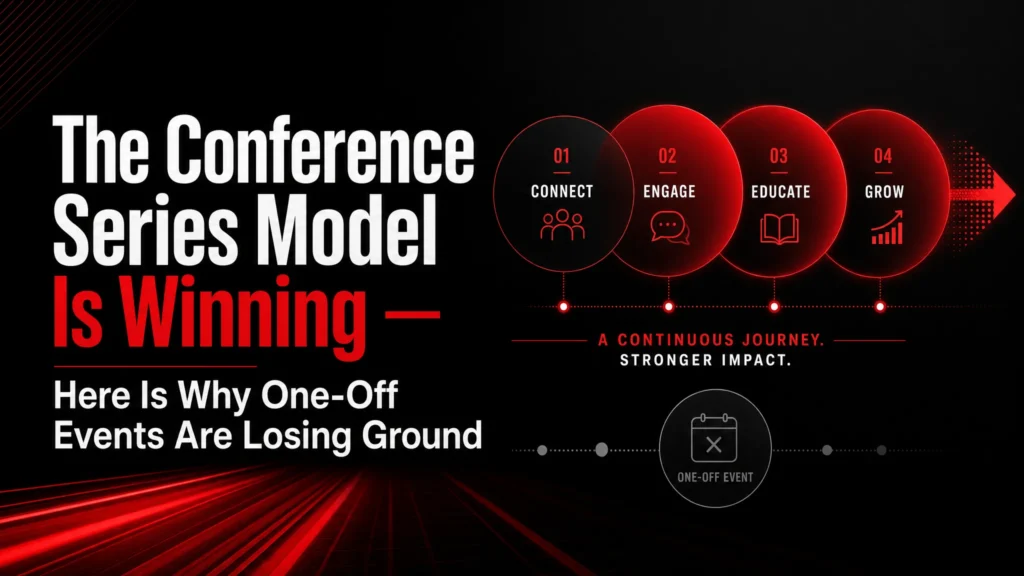
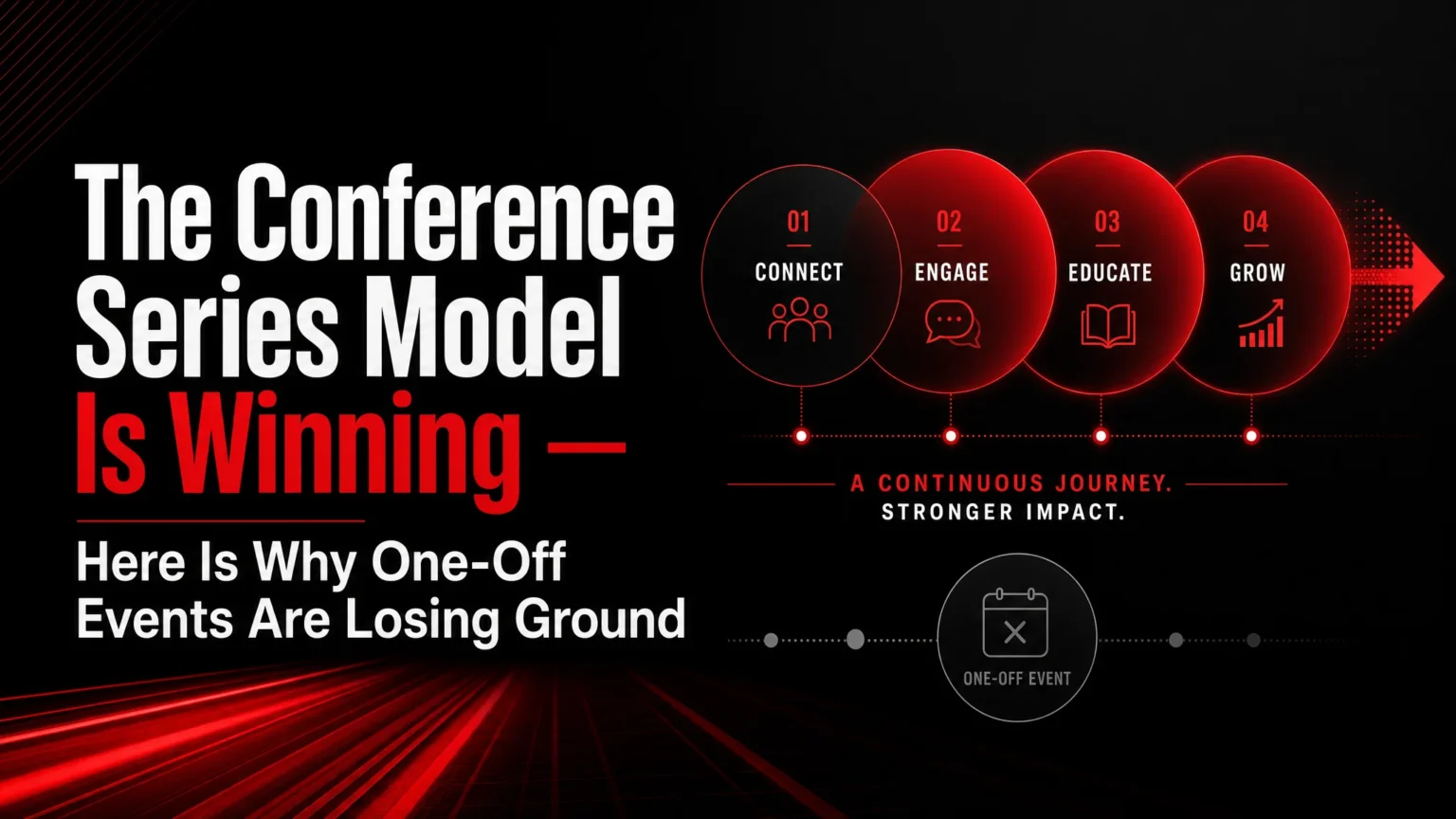
A conference series treats the program as a continuous platform. It does not start from zero each cycle. Organizers build on past events, maintain relationships with attendees, reuse proven formats, and refine each edition with real data and feedback. This creates a compounding effect over time, with engagement improving and operations becoming smoother.
Let’s take TechCon Global as an example. The organization is arranging TechCon SoCal 2026 for May 21-23. In addition, they have already successfully held two events in 2026: TechConSouthWest 2026 and TechCon Silicon Valley 2026.
Their upcoming event calendar already extends into 2027, with TechCon SouthWest, TechConSoCal, TechConX, and TechCon Silicon Valley all in the pipeline. All this reflects a single, growing program that carries its audience, brand, and momentum from one edition to the next.
Each event on TechCon Global’s calendar builds on the last. Sponsors gain ongoing visibility among a loyal, returning audience. Attendees who connected at SoCal 2026 show up at the next event already knowing people and invested in the community. That is the compounding effect in action, which a one-off event can never replicate.
Why the Conference Series Model Is Gaining Ground
The conference series model enables organizers to run multiple connected events throughout the year, such as regional conferences, niche meetups, and recurring editions of the same event.
This approach aligns more closely with how people engage today. These recurring events throughout the year help the organization stay relevant and connected.
Some of the core reasons behind the popularity of the conference series model are:
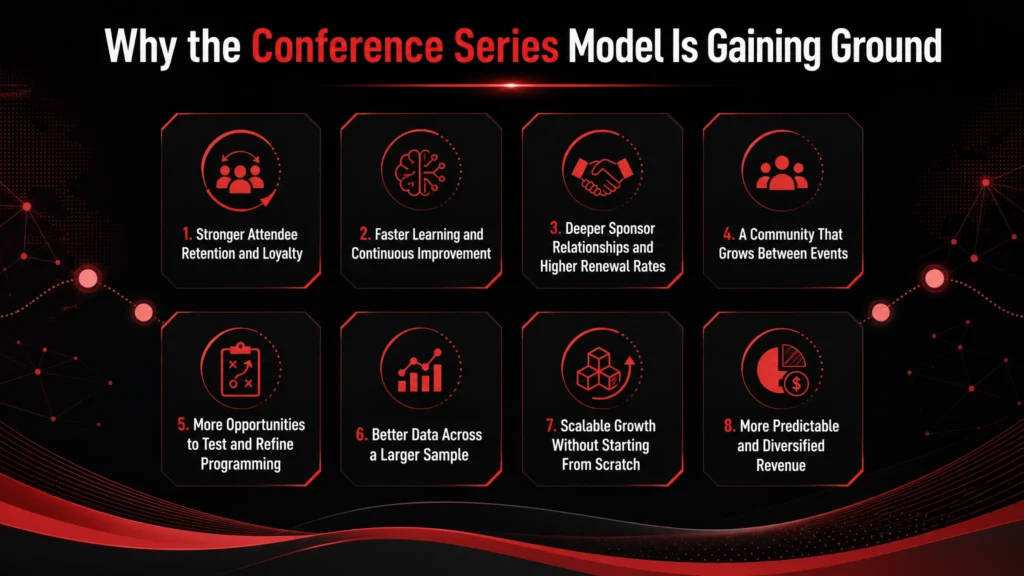
1. Stronger Attendee Retention and Loyalty
Attendees stay connected when they know another event is coming in a few months. They follow updates and have a concrete reason to remain part of the community rather than drifting away after the closing keynote.
This creates a retention environment that one-off events cannot replicate. Returning attendees also bring others, vouch for the experience, and share it within their networks. This reduces the cost of filling seats at each subsequent event in the series.
2. Faster Learning and Continuous Improvement
A single annual event gives organizers one chance per year to test a format and gather feedback. By the time those insights are applied, twelve months have passed, and much of the feedback is no longer relevant.
A series compresses that cycle. Each event feeds data into the next while the audience remains engaged and the findings are fresh. Organizers learn faster and fix problems sooner. They build better programs with every edition.
3. Deeper Sponsor Relationships and Higher Renewal Rates
Sponsors signing on to a single conference are making one bet on one outcome. Sponsors committing to a series are investing in a platform. They get repeated exposure to the same qualified audience across multiple events and multiple months.
Research shows that sponsors who see measurable ROI renew at rates above 70%, as it creates stable and predictable income for future events. A conference series model provides sponsors with more data points to evaluate their performance, which makes the renewal conversation easier. Plus, the relationship becomes more strategic on both sides.
4. A Community That Grows Between Events
Conferences create connections, while series create communities. The difference is that in a series, attendees have a reason to stay in touch between events because they know they will see the same people again soon.
That continuity changes the nature of the relationships formed. Conversations that start in a session have a follow-up touchpoint. Networking does not evaporate when the venue empties. The community builds continuously rather than assembling once a year and then immediately disbanding.
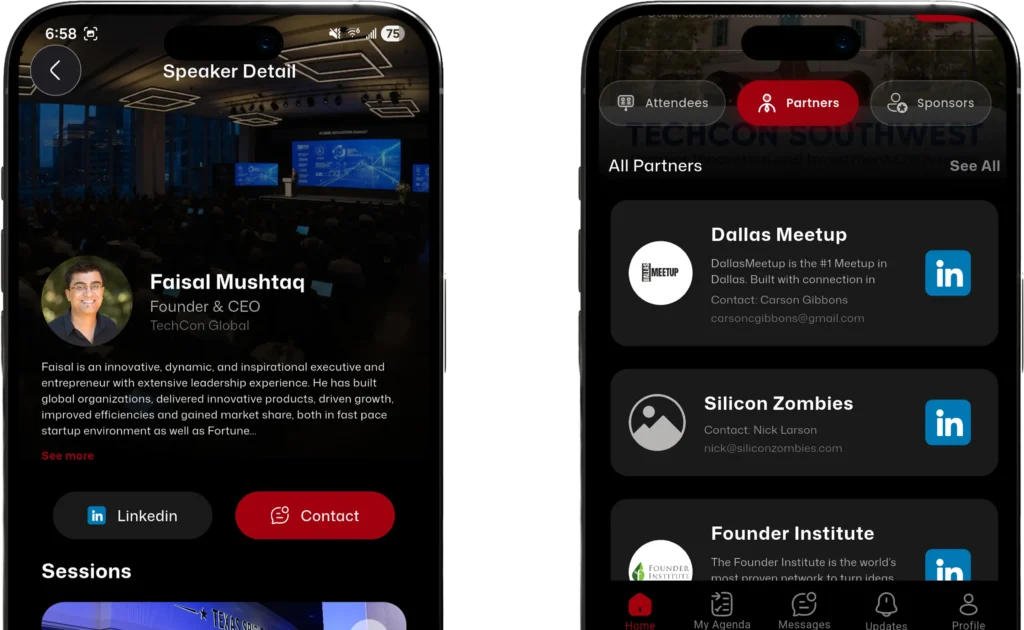
On top of that, if the organizer has deployed a conference app like Conphere, it offers built-in group chats, moderated channels, and 1:1 messaging that keep attendees connected long after the event ends and informed about upcoming events.
5. More Opportunities to Test and Refine Programming
Organizers often have plans for a new session format, speaker type, networking structure, or other activities. However, these are high-stakes experiments at a one-off event. If it does not land, the damage is done, and the correction is a year away.
A series gives organizers the freedom to experiment at lower stakes. A format that underperforms at one event can be adjusted or dropped at the next. A breakout session that generates strong engagement can be expanded. Programming evolves in response to real audience behavior and at a faster pace.
6. Better Data Across a Larger Sample
Engagement data from a single event tells one story. Engagement data collected from four or five events in the same program tells a much more useful story. It reveals patterns and trends that a single data set cannot surface on its own.
Organizers running a conference series model can track which session topics consistently draw the highest attendance and which networking formats generate the most meetings. They also learn where engagement tends to drop off. Those patterns drive smarter decisions in real time.
7. Scalable Growth Without Starting from Scratch
Every one-off event resets the clock. The organizer rebuilds the audience, re-pitches to sponsors, re-establishes the brand, and re-proves the concept. Growth is slow because there is no foundation to carry forward.
A series builds that foundation at a faster pace. Each event adds to the attendee database and the sponsor’s track record. The community’s depth carries over to the next events. Growth compounds because the work done at one event directly reduces the work required at the next.
8. More Predictable and Diversified Revenue
One-off events concentrate all revenue risk into a single window. If ticket sales are slow or a major sponsor pulls out close to the date, there is no buffer. The entire year’s program is affected by one difficult season.
A series spreads that risk across multiple events and revenue cycles. Ticket income, sponsorship commitments, and exhibitor fees are distributed throughout the year. This makes cash flow more predictable and the program more resilient to any single setback.
Conclusion
The one-off event had its moment. It worked when attendee expectations were simpler and competition was lower, and sponsors had fewer options to evaluate. None of those conditions is true anymore. The organizers running conference series today are building programs with compounding value and loyal communities, along with sponsor relationships that renew year after year. So, be the organizers who move beyond one-time events and build conference programs that become more valuable with every edition.